
Islam’s Journey to the New World: The Untold Story of African Muslims Enslaved in America
For three hundred and fifty years, Muslim men, women, and children, victims of the general insecurity that the Atlantic slave trade and the politico-religious conflicts in West Africa fostered, were sold in the New World. They were among the very first Africans to be shipped, and among the very last. When they reached the other side of the Atlantic Ocean, after a horrific journey, they introduced a second monotheistic religion (after the arrival of Catholicism and before Protestantism) into post-Columbian America. Islam was also the first revealed religion freely followed – as opposed to imposed Christianity – by the Africans who were transported to the New World. …
Resilient Muslim Enslaved Africans: Preserving Faith in Hostile America
Literate, urban, and in some cases well traveled, the Muslims realized incomparable feats in the countries of their enslavement. They came as Muslims and they lived as Muslims. The preservation of their faith and the maintenance of their lifestyle in a hostile Christian environment were in themselves no small accomplishments. Yet many historians and writers have not acknowledged their presence, much less their success at upholding their religion. The most widely held opinion among writers on slavery and on Islamic issues in the Americas is that “what Muslim faith they brought with them was quickly absorbed in their new Christian milieu and disappeared.”[1] A few scholars in the United States have recently recognized some famous Muslims and published their stories, but these figures have remained individuals, not part or representatives of a wider community, whose presence and achievements remain unknown. …
Preserving Faith and Knowledge: African Muslims’ Resilience in Slavery
With remarkable determination they maintained an intellectual life in mentally sterile surroundings. … In freedom as in enslavement, Islam was the hope of the Muslims, their strength and their comfort. … Notwithstanding the limits imposed on them by their subordinate status, many succeeded in following, to the letter, the principles of Islam. … At the same time, paradoxically, Islam was the engine of upward mobility within the structure of slavery. …
African Muslims arrived in the Americas with a tradition of Arabic literacy that they struggled to preserve. After years of study in Koranic schools and centers of higher learning, they refused to let enslavement turn them into mere beasts of burden. They kept on reading the Koran and writing in Arabic, and they even established schools. Their literacy not only set them apart from most slaves and many slaveholders but became the basis of their disproportionate influence in slave communities and, in some instances, their key to freedom. …
Islam in America: Revolt, Resilience, and a Legacy of Strength
Well organized and a galvanizing force, Islam in America was the catalyst of revolt and insubordination. It played a major part in the most elaborate slave uprisings and was the motivating force that sent freed men and women back to Africa. … Because Islam as brought by the Africans did not outlive the last slaves, one might think that the Muslims failed, that their story in the Americas speaks of defeat and ultimate subjugation. Through examining their history, their stories, and their legacy, however, this book reveals that what they wrote on the sand of the plantations is a successful story of strength, resilience, courage, pride, and dignity. …
Turbaned men and veiled women, their prayer beads around their necks, chopped cotton, cut cane, and rolled tobacco from sunup to sundown. Like other slaves, they were beaten, whipped, cursed, raped, maimed, and humiliated. They saw their families torn apart and their loved ones killed. In the midst of abuse and contempt, they continued to pray, fast, be charitable, read, write on the sand, help one another, sing their lonesome tunes, and display pride in themselves, their religion, and their culture.
The African Muslims may have been, in the Americas, the slaves of Christian masters, but their minds were free. They were the servants of Allah.
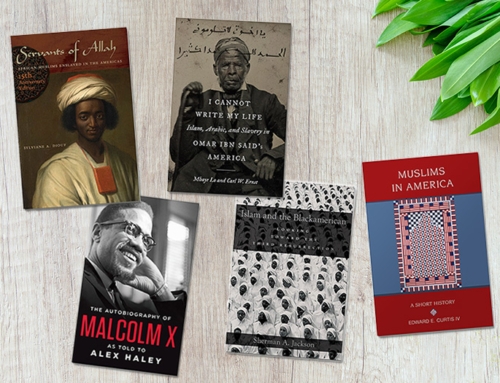
Excerpted (with permission) from Servants of Allah: African Muslims Enslaved in the Americas by Sylviane A. Diouf, Ph.D., New York University Press, 1998
[1] Caesar Farah, Islam (Hauppauge, N.Y.: Barron’s, 1994), 307.
Read More
Got Questions?
We have Answers. Get in touch now.