
Category: Asia
Baghdad: A Historical Overview
Saulat Pervez When we think of Baghdad today, we imagine a war-torn, ravaged city. However, Baghdad has a rich history which the present should not obscure. From the eighth century to the thirteenth century, Baghdad was a metropolis known for intellectual and material prosperity, showcasing numerous libraries, research institutions, thriving universities, magnificent homes, and
Baghdad: Universities and Hospitals
Universities During the later part of the 11th century, Baghdad introduced the precursor to the modern university in the form of a chain of madrasahs which housed students and a salaried faculty. They were known as the Nizamiyah, after their founder Nizam al-Mulk, a Seljuk vizier. The largest and most splendid of these was
Indonesia
Saulat Pervez On her recent visit to Indonesia in February, 2009, Secretary of State Hillary Clinton remarked, “If you want to know if Islam, democracy, modernity and women’s rights can coexist, go to Indonesia.” Italian Foreign Minister Franco Frattini expressed similar sentiments during a conference hosted by the Italian Foreign Ministry and the Rome-based Sant’
Baghdad: Libraries and House of Wisdom
Libraries Muslims learned how to make paper from the Chinese, and proceeded to transform this art into a major industry. By 793 C.E., there were many paper mills in Baghdad. This was a revolutionary development because the existing alternatives to paper were papyrus, which was fragile, and parchment, which was expensive; paper, on the
Islam in Asia: Introduction
From the Middle East to southeastern Asia, from central Asia to the Pacific Islands, the diversity in Asia is striking. Yet, despite cultural differences, the religion of Islam forms a common thread across Asia. The majority of people in countries such as Iraq, Afghanistan, Azerbaijan, and Indonesia, to name just a few, find commonality
Baghdad: A Center of Learning
As the city of Baghdad grew, it developed a reputation for learning and research. Scholars from all across the Islamic world were attracted to Baghdad, quickly turning it into an intellectual hub. This was no surprise because Islam puts so much emphasis on acquiring knowledge. In fact, the very first verses revealed to Prophet
From Mulberry to Silk – The Journey of Islam in China
By Musaddique Thange China is sometimes referred to as a “riddle wrapped in an enigma”. A nation with an ancient civilization that is one of the fastest growing economies of the modern world, a people steeped in history that also carry the promise of the future, and a country that is at once associated with
Baghdad: Decline
By the thirteenth century, the caliphate had weakened due to internal rivalries and a decadent lifestyle. In the wake of such fragmentation, the Mongols attacked in 1258 and devastated the city and its inhabitants. The civilized people of Baghdad were horrified at the savage ways of the Mongols who resorted to mass murders, pillaging, and
Baghdad: Famous Scholars
Islam was the major catalyst which enabled Baghdad to reach its glorified stature. In addition to encouraging the gathering of knowledge and the use of reasoning, Islam was more than just a religion. Being a “way of life”, it was not confined to the mosque but was apparent in everyday activities of people. The Muslims
Baghdad: Foundation
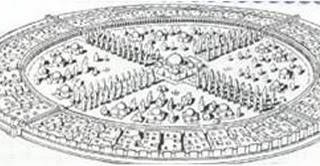
Abbasid Caliph al-Mansur founded Baghdad on July 20, 762 C.E., intending it to serve as the capital of Islam and calling it “Madinat-us-Salaam,” or City of Peace. Baghdad was also known as the Round City because it was constructed in a circular shape, consisting of towering semi-circle city walls on the right and left